Air Cooler vs Air Conditioner: What Do Factories Actually Use in Summer?
 16 Sept 2026
 Share
Share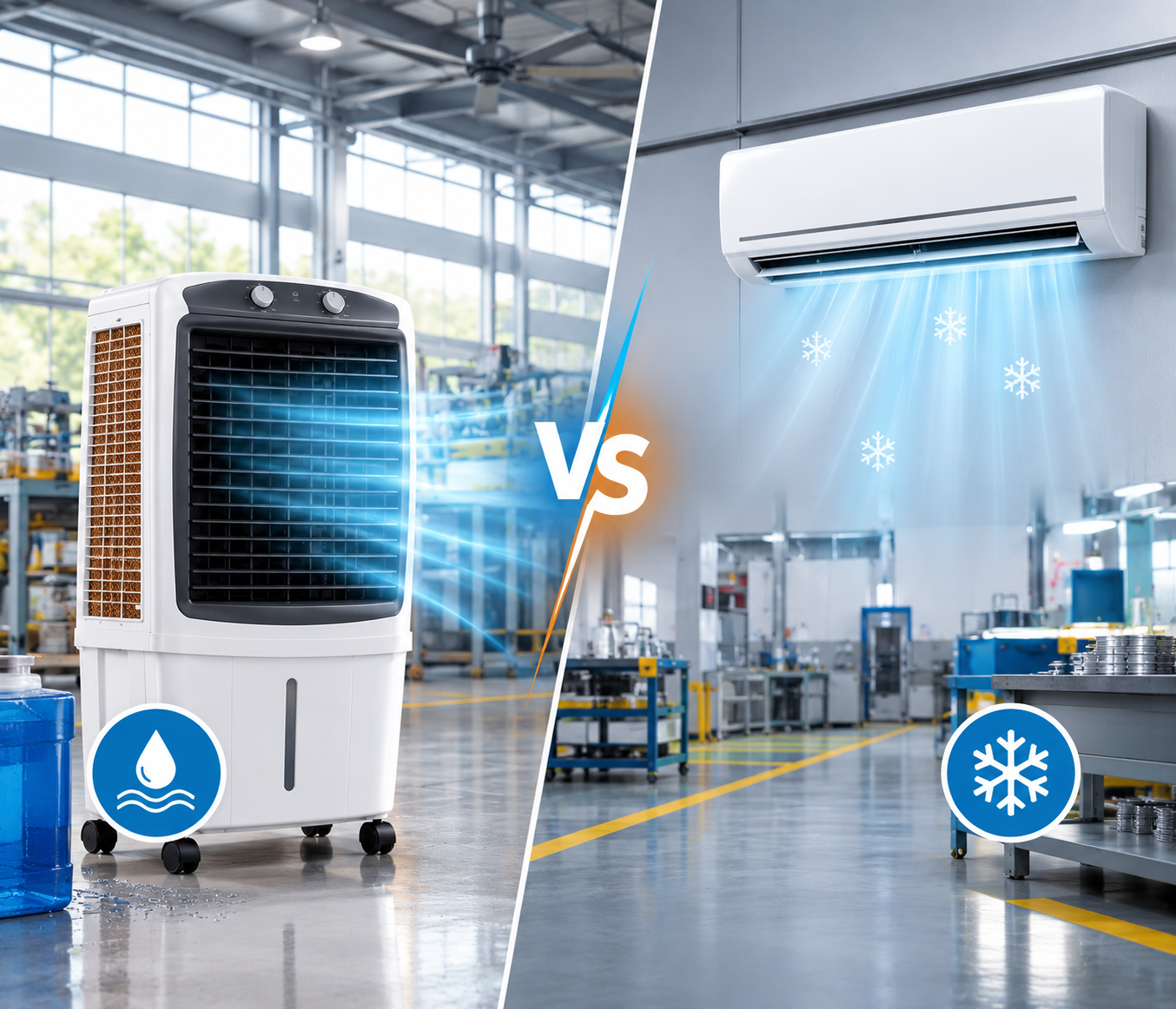
Factories do not heat up the way homes do. On a summer afternoon, the heat is already high outside, and then machines, lights, metal surfaces, production activity, and people working long shifts add to it. In many units, shutters stay partly open, and workers move in and out through the day. So cooling a factory is rarely as simple as putting an AC in the corner and expecting the whole floor to cool down.
That is why the air cooler vs air conditioner decision depends on the space. A closed office cabin inside the factory may need an AC. A large shop floor, warehouse, or semi-open work area may work better with an air cooler because it needs airflow more than sealed-room cooling. In most cases, factories do not use only one system. They use what works for each zone. A factory air cooler may be used for larger work areas, while air conditioners are kept for offices, server rooms, testing rooms, or spaces where temperature control is more specific.
Why Cooling Matters on a Factory Floor
Factory heat is not just uncomfortable; it changes the way the space functions. When the floor becomes too hot, workers tire faster, movement slows down, and long shifts become harder to manage. Heat can also make some work areas feel stuffy, especially when ventilation is poor.
Good cooling helps the factory floor stay more usable during peak summer. It keeps air moving, reduces heat discomfort, and makes the space easier to work in for longer hours. In areas where machinery or materials need a steadier environment, the right cooling setup also helps maintain better working conditions. This is why factories usually think about cooling differently from homes. The question is not just "Which system cools more?” It is "Which system makes sense for this particular space?”
Air Cooler vs Air Conditioner: Key Differences
Factor | Air Cooler | Air Conditioner |
Cooling method | Uses water evaporation to cool incoming air | Uses refrigerant and compressor-based cooling |
Best suited for | Large, ventilated areas such as workshops, warehouses, semi-open factory floors | Closed rooms such as offices, cabins, control rooms, labs, or server areas |
Ventilation need | Needs fresh air and cross-ventilation | Works best in closed spaces |
Power use | Generally consumes less electricity | Usually consumes more electricity |
Air movement | Brings in fresh outdoor air | Recirculates indoor air unless ventilation is added |
Humidity impact | Adds moisture to the air | Removes moisture from the air |
Maintenance | Needs water tank, pads, pump, and fan cleaning | Needs filter cleaning, servicing, and refrigerant checks |
Best climate | Hot and dry areas | Humid areas or closed spaces needing precise cooling |
What Do Factories Usually Use in Summer?
A lot of factories use both. The large floor area may have air coolers, while smaller enclosed spaces use ACs. This happens because a factory floor is usually too large and open for regular air conditioning to be practical. Air coolers can push air across a wider area and work better when there is ventilation. They are also more economical to run for long hours.
ACs make more sense in closed areas. For example, an admin office, control room, server room, quality testing space, or lab may need stable cooling. These areas are smaller, sealed better, and may require a fixed temperature. So the answer to air cooler vs AC is not one-size-fits-all. On the main floor, an air cooler often makes more sense. In closed rooms, an AC may be the better choice.
Why Many Factories Prefer Air Coolers for Large Spaces
A factory floor needs strong air movement. It also needs a cooling solution that can run for long hours without making electricity costs difficult to manage.
An air cooler works well in such spaces because:
- It usually consumes less power than an AC setup for a large area.
- It works better in open or semi-open layouts.
- It brings in fresh air instead of circulating the same indoor air again and again.
- It is easier to place in workshops, warehouses, sheds, and production areas.
- It suits hot and dry summer conditions better.
- It can be maintained without complicated servicing, as long as the tank, pads, pump, and fan are cleaned regularly.
For businesses looking for the best air cooler, the focus should not be only on price. Air delivery, water tank capacity, cooling pad quality, area coverage, and ease of maintenance matter more in daily use.
When Air Conditioners Make More Sense
Air conditioners are not the wrong option for factories. They are simply meant for different spaces. An AC is useful when the room needs to stay closed, and the temperature has to remain steady. This is common in offices, cabins, labs, server rooms, electronics rooms, quality control spaces, or any area where machines or materials need controlled cooling.
ACs are also better in humid regions. Since an air cooler works through water evaporation, it may not feel effective when there is already too much moisture in the air. In such cases, an AC can manage both temperature and humidity better.
Which Industries Can Use Factory Air Coolers?
A factory air cooler is usually a practical choice for spaces where air can move freely. It can be used in:
- Warehouses
- Workshops
- Manufacturing units
- Industrial sheds
- Assembly areas
- Packaging sections
- Commercial kitchens
- Large halls
- Semi-open workspaces
For closed rooms within the same building, an AC may still be needed. That mix is often the most sensible setup.
Factors to Check Before Choosing a Cooling System
Before choosing between an air cooler and an air conditioner, consider how the space is used every day.
- Size of the area: Large spaces need higher air delivery and wider coverage.
- Ventilation: Air coolers need airflow. ACs need closed rooms.
- Heat load: Machines, lighting, ovens, and people all add heat.
- Humidity: Air coolers suit dry heat. ACs work better in humid conditions.
- Running cost: A system used for long hours should not push electricity bills too high.
- Maintenance access: Coolers need water and pad cleaning. ACs need periodic servicing.
- Type of work: Some rooms may need exact temperature control, while others only need better air movement.
Common Mistakes to Avoid
- Using one cooling system for the whole factory without checking room-wise needs.
- Installing an air cooler in a sealed space with no ventilation.
- Choosing a small cooler for a large work area.
- Looking only at purchase cost and ignoring running cost.
- Forgetting regular cleaning of pads, tank, pump, and vents.
- Ignoring future expansion while planning cooling capacity.
- Using ACs in open areas where cooled air escapes quickly.
These mistakes usually show up later as poor cooling, high bills, or repeated maintenance issues.
Maintenance Tips for Factory Air Coolers
A cooler used in an industrial space needs more attention than one used at home because dust and heat loads are usually higher.
Clean the cooling pads regularly so dust and mineral deposits do not block airflow. Keep the water tank clean to avoid odour, scaling, and algae build-up. Check the pump to make sure water is reaching the pads evenly. Fan blades and vents should also be cleaned because dust can reduce air throw.
Placement matters too. The back panel should have enough space for air intake. If the cooler is pushed too close to a wall, cooling will drop even if the machine is working fine.
Where Hindware Coolers Fit In
For spaces where evaporative cooling makes sense, a Hindware cooler can be considered as part of the broader Hindware home appliances range. The brand offers air cooler options designed for Indian summer conditions, including models suited for home, office, and larger space cooling needs.
The right choice still depends on the actual site. Area size, ventilation, humidity, water capacity, and usage hours should be checked before selecting a model. A cooler that works well for a small office may not be enough for a factory floor, and a large cooler may be unnecessary for a small enclosed room.
Choose the Right Cooling Setup with Hindware Appliances
Factories usually do not need the same cooling system everywhere. Large, ventilated floors often work better with air coolers, while closed rooms may need air conditioners for controlled cooling. That is the practical answer to the air cooler vs AC question.
For hot and dry spaces, the best air cooler is one that matches the area size, airflow need, water capacity, and daily usage hours. A Hindware cooler from the Hindware home appliances range can be a practical option where evaporative cooling makes sense, especially when chosen with the right capacity and maintained through summer.